Could Lead Be Getting Into My Water at Home?
Lead usually comes from the pipes between the street and your faucet, not the treatment plant. Here’s where to look, how to test the right tap and how to protect the water you drink.
Also asked: What Doesn’t My Water Report Tell Me? · Do I Need Whole-Home Reverse Osmosis?
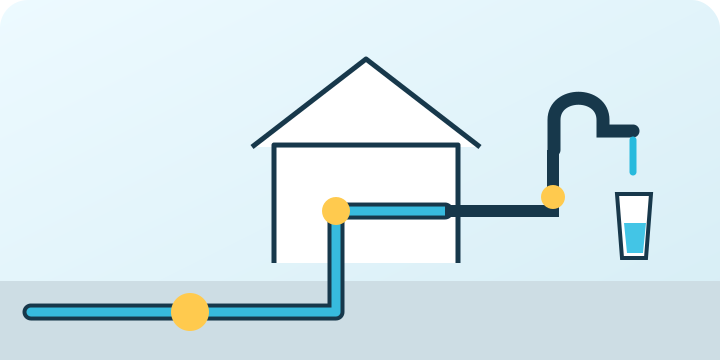
The last stretch to your tap
In this guide
The short answer
It can. Utilities treat water to limit corrosion, but lead can still come from a lead service line, older solder or brass fixtures between the street and your faucet. You can’t see, taste or smell it. A lab test from your drinking tap tells you what’s there, and a point-of-use system with a lead-reduction claim adds a barrier right where you fill your glass.
Where lead comes from
Water leaves the treatment plant, then travels through the service line to your house and through your own pipes and fixtures. CDC lists lead service lines, older lead solder, certain brass fixtures and galvanized pipe as the places to look. Lead solder was banned for drinking-water plumbing in 1986, so older homes deserve a closer look, but newer homes can still have fixtures that add some lead.
Lead gets in through corrosion, so water that sits in the pipes overnight can carry more than water that has been running.
Check your service line
Utilities had to publish service line inventories in 2024. Ask yours what it lists for your address: lead, not lead, or unknown. EPA’s 2024 rule requires most utilities to find and replace lead service lines within 10 years, so ask about replacement programs too.
Test the right tap
A hardness strip, chlorine test or TDS meter can’t find lead. Use a lab that tests for it, follow its collection instructions exactly and sample the faucet you actually drink from. First-draw samples after water has sat in the pipes answer a different question than samples taken after flushing, so let the lab guide you.
What to do right now
- Use cold water for drinking, cooking and baby formula. Hot water picks up more lead.
- Run the tap for a bit when water has been sitting for hours.
- Clean faucet aerators, where small particles can collect.
- Don’t boil water to remove lead. Boiling doesn’t remove it.
Treat the water at the tap you drink from
A point-of-use filter certified for lead reduction is a recognized way to reduce lead in drinking water, and many reverse osmosis systems carry that claim. Because the treatment sits at the faucet, it works after the water has passed through every pipe and fitting in your house.
Replacing a lead line or fixture fixes the source. That’s a job for your utility or a plumber. Protecting the water your family drinks in the meantime is ours.
How Sunstorm handles drinking water
We put the finest treatment where it matters most, the water your family drinks, then take care of every other tap so the whole house benefits.
HydroSip RO
Four-stage reverse osmosis under the sink with its own faucet, for drinking water, coffee, cooking and ice.
See HydroSip →HydroOne or HydroDuo
Catalytic carbon, KDF and 10% cross-linked softening resin treat the water where it enters your home, so every shower, sink and appliance gets filtered, soft water.
See HydroOne →Want RO at every tap? We install Hydro360 whole-home reverse osmosis too. For most homes, filtration and softening plus kitchen RO is the better value: the same drinking water at the sink, without paying to purify the water you shower, flush and wash with. See Hydro360
Questions homeowners ask
Does my utility’s report show lead at my house?
No. It shows the utility’s sampling across many homes. Only a sample from your own faucet tells you about your plumbing.
Does boiling remove lead?
No. Boiling doesn’t remove lead, and it concentrates what’s there as water evaporates.
Does a water softener remove lead?
A softener isn’t built or tested for lead. Use a point-of-use system with a lead-reduction claim.
What should I bring when I talk to Sunstorm?
Your lab result, a photo of the sink cabinet and anything you know about the plumbing. We’ll match kitchen treatment to it and show you the performance documentation.
Sources
- CDC: lead in drinking water
- EPA: Lead and Copper Rule Improvements
- EPA: what your water system is doing about lead
- CDC: choosing home water filters
- NSF: reverse osmosis systems
About this guide: We check our guides against current EPA, CDC, state and utility sources and update them as rules and equipment change.