
PFAS and PFOS in Central Florida Drinking Water: What Homeowners Should Know in 2026
PFAS are a large family of manufactured chemicals used for decades in products designed to resist heat, oil, grease, stains, and water. PFOA and PFOS are the two compounds most familiar to the public because they have been widely studied and now have federal drinking-water limits.
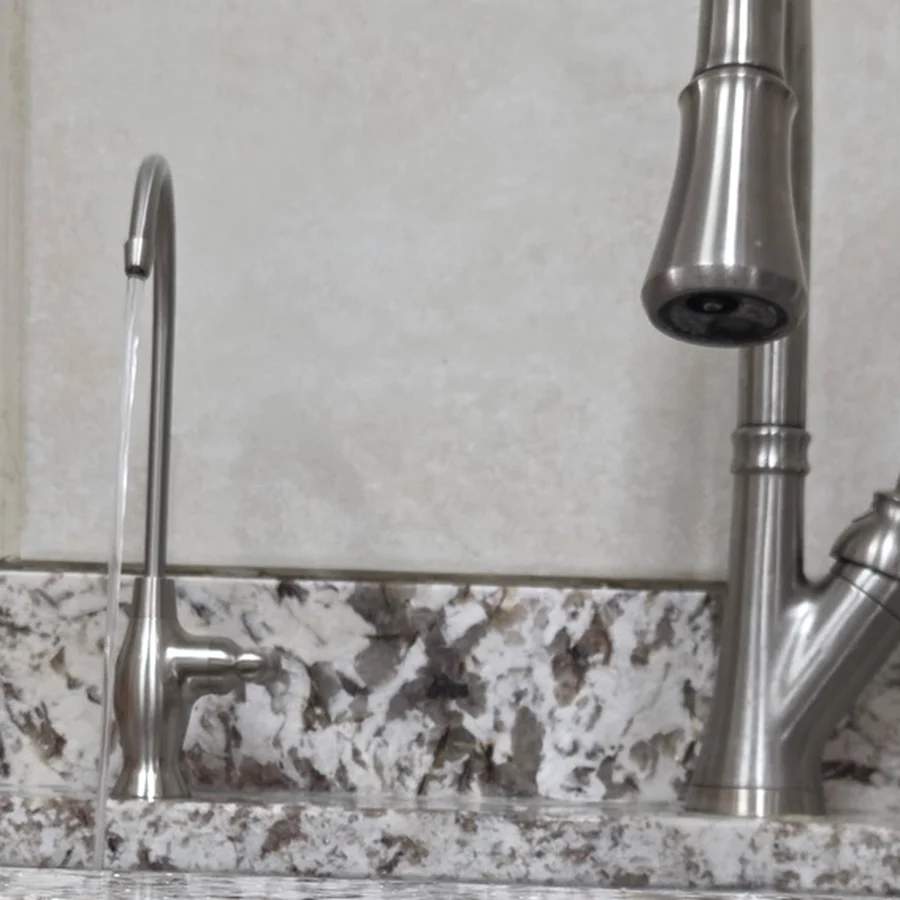
Start with the address. Which utility serves it, and what did that utility's latest monitoring show? Then decide whether the goal is drinking water at the kitchen tap or every gallon entering the home. Any equipment you compare should have a verified PFAS reduction claim for the exact model.
Why PFAS receive so much attention
Many PFAS contain strong carbon-fluorine bonds that break down slowly. Some compounds can persist in water, soil, wildlife, and the human body.
PFAS have been associated with:
- Aqueous firefighting foam
- Metal plating and industrial uses
- Nonstick and stain-resistant products
- Water-resistant clothing and textiles
- Grease-resistant food packaging
- Some cosmetics and consumer products
- Waste-disposal and wastewater pathways
"PFAS" is not one chemical. It describes thousands of substances with different properties. A filter tested for PFOA and PFOS should not automatically be described as reducing every PFAS compound.
The federal drinking-water limits in 2026
EPA's enforceable maximum contaminant levels for PFOA and PFOS are 4.0 parts per trillion each.
In May 2026, EPA proposed an optional process that could allow eligible public water systems up to two additional years - until 2031 - to comply with the PFOA and PFOS limits. EPA said the proposal would not change the 4.0-ppt standards.
EPA separately proposed rescinding the federal limits for PFHxS, PFNA, HFPO-DA, commonly called GenX, and the hazard-index mixture. Both actions were still proposals as of July 2026, so current EPA information should be checked whenever a utility result or treatment decision depends on the rule. (EPA PFAS drinking-water regulation)
One part per trillion is an extremely small concentration. At that scale, sampling method, laboratory reporting limit, sampling location, and averaging rules all matter.
Start with the utility serving the property
An Orlando mailing address does not identify the water provider by itself. Homes in the region may be served by OUC, Orange County Utilities, a city utility, a private system, or a community well.
Check the name on the water bill, then look for:
- The latest Consumer Confidence Report
- A PFAS or UCMR 5 results page
- The sampling date
- The facility or source represented
- Results for individual compounds
- The laboratory reporting limit
OUC states that it participated in EPA's UCMR 5 monitoring and makes its April 2025 sampling results available through its water-services page. Orange County Utilities also publishes water-quality and PFAS information online. (OUC water services; Orange County Utilities water quality)
Use the newest result from the correct provider. A result from another part of Central Florida cannot describe the water at every address.
How to understand a PFAS result
PFAS data may be presented in nanograms per liter, which is numerically equivalent to parts per trillion for water.
A reported concentration
Compare the number with the standard for that exact compound and note whether it represents one sample or a running annual average.
A non-detect
"Non-detect" means the compound was not measured at or above the laboratory's reporting threshold. Check that threshold. A reporting limit above the level of interest provides less information than a lower one.
Source water versus finished water
Source-water results describe water before treatment. Finished-water results describe water leaving the treatment facility. Distribution samples provide information farther into the system. Do not treat those sample types as interchangeable.
One result versus a pattern
A single sample is a snapshot. Repeated monitoring shows whether a compound is consistently absent, present at a stable level, or changing.
Which treatment technologies are used for PFAS reduction?
EPA identifies three widely used approaches:
- Granular activated carbon
- Ion-exchange media designed for PFAS
- Reverse osmosis
Performance depends on the PFAS compound, influent concentration, flow, contact time, media capacity, water chemistry, pretreatment, and maintenance. Short-chain PFAS can be more difficult for some adsorptive media than PFOA and PFOS. (EPA home-filter guidance)
Point-of-use reverse osmosis
An under-sink RO system treats water for drinking and cooking at one faucet. For many homeowners, this is the most focused way to address ingestion without treating showers, toilets, irrigation, and laundry.
Look for the exact model in an accredited certification directory with a PFAS reduction claim under NSF/ANSI 58. Check:
- The specific compounds in the claim
- Tested influent and effluent levels
- Rated daily production
- Recovery and efficiency
- Prefilter and membrane replacement requirements
- Whether the certification applies to the complete installed configuration
RO also reduces total dissolved solids and many other substances, but the exact claims vary by model.
Activated carbon
Granular activated carbon can reduce PFOA and PFOS when the system has enough media, contact time, and capacity for the water being treated.
A refrigerator cartridge, pitcher, under-sink carbon block, and full-size point-of-entry tank do not have the same capacity or flow conditions. For a PFAS claim, look for the exact model under NSF/ANSI 53 and follow the replacement interval.
Carbon does not signal when it is exhausted. Replace it according to the tested capacity and actual use. Do not wait for the water to taste different.
PFAS-selective ion exchange
Specialized anion-exchange media can be effective in utility and engineered household applications. It is different from the cation-exchange resin used by a normal hardness softener.
A standard softener removes calcium and magnesium. PFAS treatment requires media and a system specifically designed and documented for the PFAS goal.
Certification deserves a closer look
EPA recommends filters certified for PFAS reduction under NSF/ANSI 53 or NSF/ANSI 58. EPA also cautions that current certification protocols may not demonstrate reduction all the way to the new 4.0-ppt federal limit.
Before choosing equipment, verify:
- Manufacturer and exact model
- Certification body
- Standard and specific PFAS claim
- Rated capacity and flow
- Replacement interval
- Feed-water conditions used in testing
- Where treated water is delivered
A logo on a component or brochure is not the same as a searchable listing for the finished system. (EPA certified-filter guidance)
Point-of-use or whole-home treatment?
Point-of-use is often the practical first option when:
- The primary goal is drinking and cooking water
- The family wants a certified, maintainable treatment point
- Utility data shows a level the homeowner wants to reduce further
- Whole-home treatment is not justified by the exposure goal
Whole-home treatment may deserve evaluation when:
- Current testing confirms a property-specific concern
- The homeowner has a clear reason to treat all indoor uses
- The system is engineered for household peak flow
- Media capacity and replacement are clearly defined
- Pressure, drainage, space, and disposal are addressed
Whole-home treatment is not automatically more protective. A properly selected point-of-use system can provide a more targeted and verifiable drinking-water result.
When independent testing is useful
Public-utility monitoring is the first source for municipal water. Independent laboratory testing may be useful for:
- A private well, which is outside Sunstorm Home's municipal-water service scope
- A property near a known release area
- Confirmation before a major treatment investment
- A homeowner who needs a tap-specific result
Use a laboratory experienced with EPA PFAS methods and follow its sampling instructions carefully. PFAS samples can be contaminated by common materials used during collection.
What to do if PFAS is your concern
- Confirm the water provider.
- Download the newest PFAS and water-quality results.
- Identify the compounds, concentrations, reporting limits, and sample dates.
- Decide whether the goal is drinking water or the entire home.
- Compare exact certified models and replacement costs.
- Keep the certification listing and maintenance schedule with the system records.
- Recheck utility data as monitoring and federal rules evolve.
Frequently asked questions
Are PFOA and PFOS banned from drinking water?
EPA has established enforceable limits of 4.0 parts per trillion for each. Public systems monitor and must comply according to the applicable federal schedule and any state requirements.
Does reverse osmosis reduce PFAS?
Some RO systems are independently certified for reduction of specific PFAS. Verify the exact model and claim under NSF/ANSI 58.
Does a normal water softener remove PFAS?
A conventional softener is designed to remove hardness minerals. PFAS-selective ion exchange is a different media and application.
Is bottled water guaranteed to be PFAS-free?
No. FDA found detectable PFAS in 10 of 197 bottled-water samples collected in 2023 and 2024. None of the detections would have exceeded EPA's public-water MCLs if those standards applied to the samples. (FDA bottled-water results)
How often should a PFAS filter be replaced?
Follow the certified capacity and manufacturer's schedule for the exact model. Flow, water chemistry, and PFAS concentration can affect service life.
Official sources
- EPA - PFAS Drinking Water Regulation and Current Actions
- EPA - Identifying Drinking Water Filters Certified to Reduce PFAS
- EPA - Reducing PFAS in Your Drinking Water With a Home Filter
- OUC - Water Services and PFAS Monitoring
- Orange County Utilities - Water Quality
- FDA - PFAS Testing Results for Bottled Water
About this guide: Utility programs, regulations and equipment specifications can change. Treatment performance depends on the water, system design, certified reduction claims and maintenance.